Is It Legal to Monitor Someone’s Phone? Laws by State

Phone monitoring laws determine what surveillance is legal in your state. Phone monitoring is legal in some situations and a federal crime in others. The difference comes down to three factors: who you’re monitoring, whether they consent, and which state you’re in.
This guide breaks down the phone monitoring laws by state, federal rules, consent requirements, and the specific scenarios where monitoring is legal — including parental monitoring, employee surveillance, and spousal tracking.
This article provides general legal information, not legal advice. Laws vary by jurisdiction and change frequently. Consult a licensed attorney in your state before monitoring anyone’s phone.
What Do Federal Laws Say About Phone Monitoring?

Two federal laws govern phone monitoring in the United States: the Electronic Communications Privacy Act (ECPA) of 1986 and the Computer Fraud and Abuse Act (CFAA).
Together, they set the baseline that all states must follow.
| Law | What It Covers | Penalties |
|---|---|---|
| ECPA / Wiretap Act (18 U.S.C. 2511) | Intercepting calls, texts, emails in transit | Up to 5 years prison + $250K fine |
| Stored Communications Act (18 U.S.C. 2701) | Accessing stored electronic communications | Up to 5 years prison + $250K fine |
| Computer Fraud and Abuse Act (18 U.S.C. 1030) | Unauthorized access to computers/devices | Up to 10 years prison + fines |
| Pen Register Act (18 U.S.C. 3121) | Recording phone numbers dialed/received | Up to 1 year prison per violation |
The ECPA requires at least one-party consent for recording communications. This means you can legally record a conversation you’re part of, but you cannot intercept communications between two other people.
The ECPA was written in 1986 — before smartphones, GPS tracking, or cloud storage existed. Courts regularly interpret its outdated language to cover modern monitoring technology.
How Do State Consent Laws Differ?
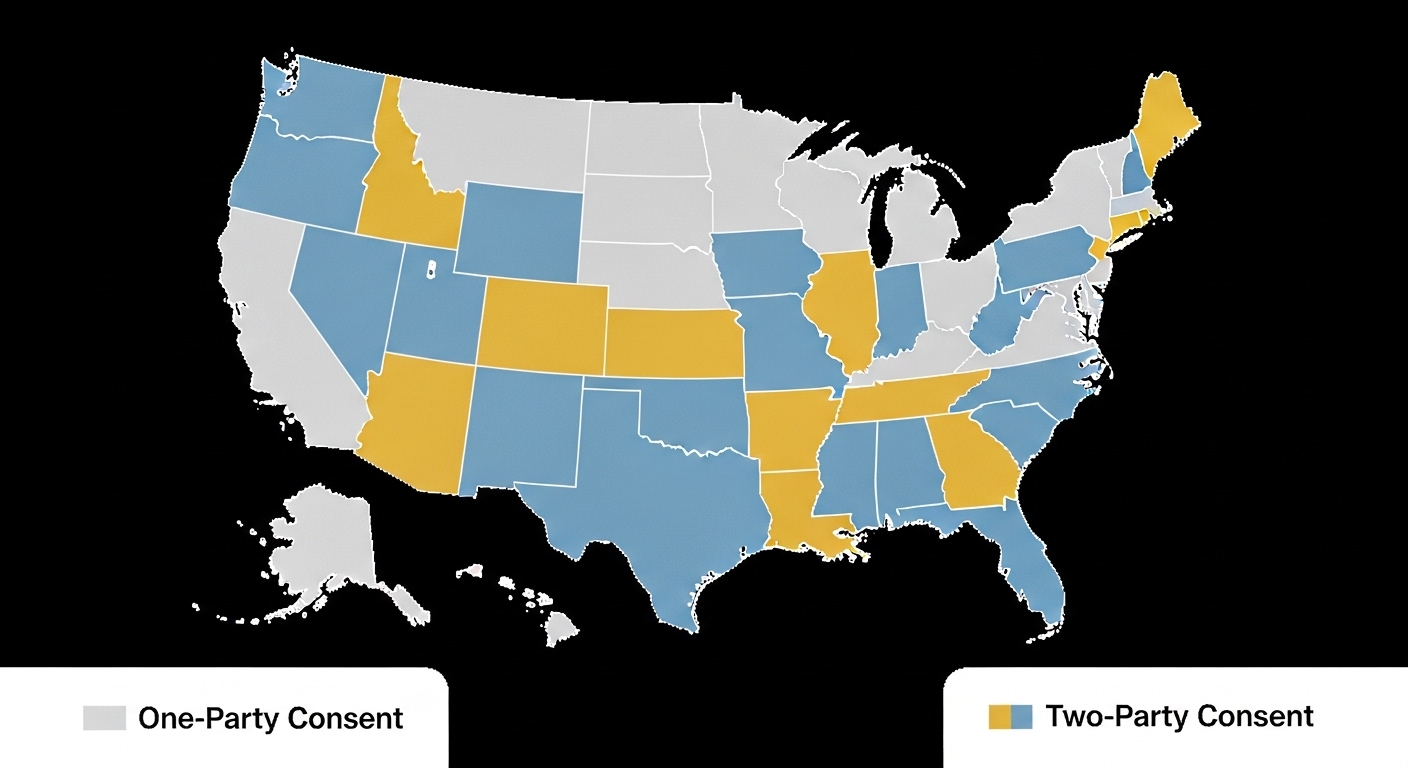
States fall into two categories for recording consent: one-party consent and two-party (all-party) consent. This directly affects whether you can legally monitor phone calls and messages.
| Two-Party Consent States | Key Details |
|---|---|
| California | Penal Code 632 — all parties must consent, $2,500 fine per violation |
| Florida | Statute 934.03 — felony to intercept without all-party consent |
| Illinois | 720 ILCS 5/14-2 — eavesdropping is a Class 4 felony |
| Maryland | Courts & Judicial 10-402 — all parties must consent |
| Massachusetts | Ch. 272 §99 — one of the strictest wiretapping laws in the US |
| Pennsylvania | 18 Pa.C.S. 5703 — third-degree felony without all-party consent |
| Washington | RCW 9.73.030 — consent of all parties required |
| Connecticut, Michigan, Montana, Nevada, New Hampshire | Various statutes requiring all-party consent |
Recording a call in a two-party consent state without everyone’s knowledge is a criminal offense — penalties range from misdemeanors to felonies.
“The biggest legal mistake I see is people assuming their state’s laws apply everywhere. If you’re in a one-party state but the person you’re recording is in a two-party state, the stricter law typically applies.”
Alex Rivera, CEH, OSCP
GPS tracking has separate rules in many states. Some states like California and Texas have specific anti-stalking laws that criminalize tracking someone’s location without consent, even when phone call recording might be legal under one-party consent.
Is It Legal for Parents to Monitor Their Child’s Phone?

Yes — in most cases. Parents have broad legal authority to monitor their minor children’s devices and online activity. Federal law recognizes parental rights to protect children, and most state laws explicitly exempt parental monitoring.
Parental monitoring apps like Hoverwatch are designed specifically for this legal use case. They provide GPS tracking, call logs, message monitoring, and app usage reports while operating within parental rights laws.
Best practice: tell your child you’re monitoring their phone. Courts look more favorably on transparent monitoring, and child psychologists agree it builds trust while maintaining safety.
Can Employers Legally Monitor Employee Phones?

Employers can monitor company-owned devices with proper notice. Monitoring personal devices is far more restricted and requires explicit employee consent in most states.
| Scenario | Legal? | Requirements |
|---|---|---|
| Company phone, with written policy | Yes | Employee must acknowledge monitoring policy |
| Company phone, no notice | Risky | Legal in some states but invites lawsuits |
| Personal phone, with consent (BYOD) | Yes, limited | Only work-related apps and data |
| Personal phone, no consent | No | Violates ECPA and state privacy laws |
| GPS tracking company vehicles | Yes | Must notify employees in most states |
| GPS tracking personal vehicles | No | Illegal without consent or court order |
Phone monitoring laws center on one key principle: reasonable expectation of privacy. On a company-owned device with a clear monitoring policy, employees have minimal privacy expectations. On a personal phone, even during work hours, privacy expectations remain high.
A 2024 survey by the American Management Association found that 78% of major companies monitor employee communications. Of those, only 62% provide clear written notice to employees.
What About Monitoring a Spouse or Partner?

Spousal monitoring is one of the most legally complex areas. Even married couples have privacy rights, and installing spyware on a spouse’s phone is illegal in most circumstances.
Installing spyware on a spouse’s phone — even during marriage — can result in federal felony charges under the CFAA and Wiretap Act.
“In divorce proceedings, evidence obtained through illegal phone monitoring is typically inadmissible and can result in criminal charges against the person who installed the spyware. It hurts your case, not helps it.”
Jennifer Walsh, Family Law Attorney, California State Bar
If you suspect a spouse of infidelity or hidden financial activity, hire a licensed private investigator instead. They know the legal boundaries and can gather evidence that’s actually admissible in court.
What Are the Penalties for Illegal Phone Monitoring?

Penalties depend on which laws were violated and whether the case is prosecuted at the federal or state level. Both criminal and civil penalties apply.
Beyond legal penalties, illegal monitoring can affect custody decisions, divorce settlements, and professional licensing. Several states now have specific anti-stalking laws that treat unauthorized phone monitoring as stalking behavior.
The legal consequences are severe enough that even suspecting illegal monitoring should prompt you to check your phone. Learn how to detect if someone is spying on your phone.
How Can You Monitor Legally and Stay Protected?

Phone monitoring laws allow surveillance when three principles are met: ownership, consent, and transparency. Follow these guidelines to stay within the law regardless of your state.
| Monitoring Type | Legal Requirements | Best Practice |
|---|---|---|
| Parental (minor child) | Legal in all states on parent-owned devices | Inform the child, document your policy |
| Employee (company device) | Written policy + employee acknowledgment | Include in employee handbook, annual reminder |
| BYOD (personal device at work) | Explicit written consent for specific apps | Limit monitoring to work apps only |
| Spouse/partner | Mutual consent required for personal devices | Use shared accounts, not secret monitoring |
| Self-monitoring (your own device) | Always legal | Use for theft recovery, location tracking |
When in doubt, get consent in writing. A simple signed statement that the person agrees to monitoring eliminates almost all legal risk in every state.
Legal phone monitoring protects families and businesses — illegal surveillance destroys trust and invites prosecution.
Final Thoughts
Phone monitoring laws come down to consent and ownership. Parents monitoring minor children’s devices are protected in every state. Employers monitoring company phones need written policies. Everyone else needs explicit consent.
If you’re considering monitoring someone’s phone, check your state’s consent laws first. When in doubt, consult an attorney — the penalties for illegal monitoring are severe enough that getting legal advice first is always worth the cost.
Frequently Asked Questions
Yes, in all 50 states. Parents have legal authority to monitor minor children's devices, especially devices the parent owns or pays for. This includes reading texts, tracking location, monitoring apps, and reviewing call logs. The legal authority typically ends when the child turns 18, regardless of who pays for the phone. Best practice is to inform your child about the monitoring.
On company-owned devices, some states allow monitoring without notice, but it's legally risky and invites lawsuits. Connecticut and Delaware specifically require employers to notify employees before monitoring. On personal devices, monitoring without consent is illegal everywhere. Best practice: include monitoring disclosure in your employee handbook and require signed acknowledgment.
It depends on whether you're in a one-party or two-party consent state. In 38 states (one-party), you can record calls you're part of without telling the other person. In 12 states (California, Florida, Illinois, Maryland, Massachusetts, Pennsylvania, Washington, Connecticut, Michigan, Montana, Nevada, New Hampshire), all parties must consent. If the call crosses state lines, the stricter law typically applies.
No. Installing spyware on a spouse's personal phone without their consent violates federal law (CFAA and Wiretap Act) regardless of marital status. Evidence obtained this way is inadmissible in divorce court and can result in criminal charges against you. Instead, hire a licensed private investigator who can legally gather evidence, or consult a divorce attorney about legal discovery methods.
Check for signs of spyware: unusual battery drain, high data usage, phone running hot while idle. Run a security scan with Malwarebytes or Lookout. Check your installed apps for anything unfamiliar. If you confirm monitoring, document the evidence, change all passwords from a different device, and consult an attorney about your legal options — including filing a police report and civil lawsuit for damages.